Over 100 participants come together for the PeaceTech Hackathon 2026
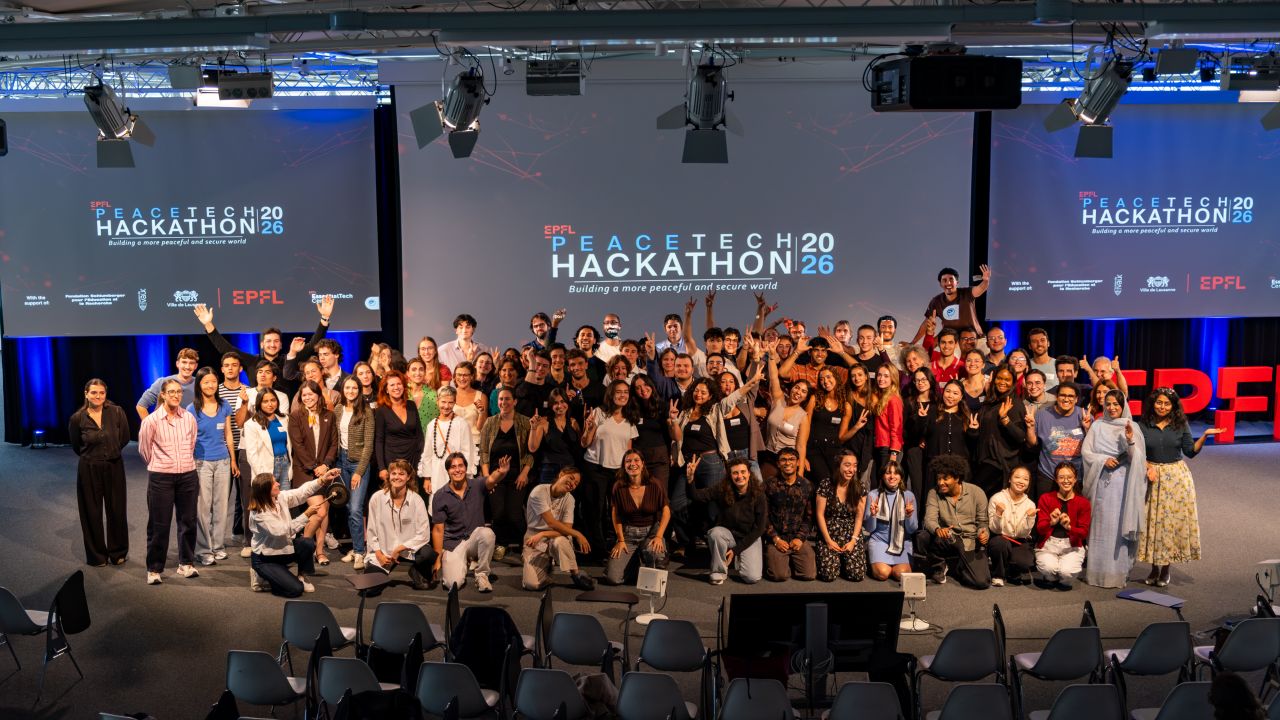
Organised by the EPFL EssentialTech Centre, the Hackathon invited multidisciplinary teams to tackle challenges at the intersection of technology and peace. Over two days, participants explored how technology can be used responsibly to address misinformation, disinformation and hate speech, with a particular focus on their gendered impacts.
“The PeaceTech Hackathon is about bringing different disciplines, perspectives and experiences together to work on difficult problems — problems that matter. For us, PeaceTech is not only about what technology can do, but about what it does to people, communities and institutions — and what we want it to do differently. The Hackathon is where ideas begin, not where they should end. ”
Mariazel Maqueda López, Head of PeaceTech, EPFL EssentialTech Centre
The Hackathon builds on EssentialTech Centre's wider work on misinformation, disinformation and hate speech (MDH). Ahead of this year's Hackathon, the Centre launched the MDH Research Landscape [hyperlink text to: https://mdh.peacetech.ch/], a new platform mapping research and initiatives across EPFL addressing these challenges. The platform brings together expertise from across the institution and provides a resource for understanding the work already underway in this rapidly evolving field.
Ten challenges were brought to the Hackathon by partner organisations working directly on these issues. The 2026 challenge partners were the Canton de Vaud's Bureau de l'égalité entre les femmes et les hommes (BEFH), décadréE, Humanity & Inclusion, the International Committee of the Red Cross (ICRC), the International Observatory for Peace, Democracy and Human Rights, the Olympic Refuge Foundation, the United Nations Institute for Disarmament Research (UNIDIR), UN Women, the United Nations Population Fund (UNFPA) and UNICEF.
Working closely with challenge partners, teams had just two days to understand their challenge, explore possible responses and develop and pitch a solution.
At the end of the weekend, each team presented its solution to a jury, marking the culmination of two intensive days of research, discussion, prototyping and collaboration.
While the Hackathon itself may be over, the ambition is for the ideas generated during the weekend to go further, with opportunities to explore how promising solutions could be developed beyond the event.
A special thank you to the Fondation Schlumberger pour l'Éducation et la Recherche, the Canton de Vaud's Bureau de l'égalité entre les femmes et les hommes (BEFH) and the Ville de Lausanne, whose support made this initiative possible.
Building PeaceTech expertise at EPFL
The 2026 event was the second edition of the PeaceTech Hackathon and forms part of EssentialTech's wider work to advance PeaceTech research and expertise at EPFL. Together with initiatives such as the new MDH Research Landscape, it aims to connect research and expertise across disciplines with organisations confronting challenges to peace in the real world.
More publications or events

Tech4Dev at the ChangeNOW Summit in Paris in April 2026